

Imagine deploying a piece of software today.
Now imagine that deployment continues running for decades.
No SSH.
No cloud console.
No physical access.
No quick rollback.
No engineer sitting beside the machine.
And now imagine that the machine is more than 15 billion miles away from Earth.
If something breaks, you cannot simply walk over to it. You send a command. Then you wait. And wait. And wait.
This isn't science fiction. This is Voyager 1.
Launched in 1977, Voyager 1 has spent decades traveling through space, carrying computers and software designed in an entirely different technological era. And when its software and computer systems began experiencing critical anomalies, NASA engineers had to do something that sounds almost impossible:
They had to debug and modify software on a computer they could never physically touch.
The Core Premise
The real test of software isn't whether it works when you build it. It's whether someone can understand, maintain, and recover it long after you're gone.
A Production System 15 Billion Miles Away
Most software engineers are familiar with production incidents. A service crashes. A database starts behaving unexpectedly. A deployment introduces a bug. A server runs out of memory.
And then comes the familiar incident-response process: Check the logs. Open the dashboard. SSH into the server. Reproduce the issue. Deploy a patch. Roll back if necessary.
Voyager doesn't have that luxury.
The spacecraft communicates with Earth through NASA's Deep Space Network (DSN). Because of the astronomical distance, a radio signal traveling at the speed of light takes roughly 22.5 hours to travel from Earth to Voyager 1.
That means a command sent from Earth takes about 22.5 hours to arrive. And the response takes another 22.5 hours to return. A simple request-and-response cycle can therefore take approximately 45 hours.
Imagine debugging a production incident where every single experiment takes almost two full days to receive a result. That is the operational environment NASA engineers navigate.
Then Something Went Wrong: The November 2023 Telemetry Anomaly
In November 2023, Voyager 1 developed a serious communication breakdown.
The spacecraft was still communicating with Earth. That was the good news—the carrier signal was steady. The bad news? The data coming back was completely unusable. Instead of meaningful engineering telemetry and scientific readings, Voyager was transmitting repeating patterns of binary ones and zeroes.
For engineers on Earth, this created a vexing debugging dilemma. The spacecraft was alive. It could communicate. But the telemetry pipeline needed to understand what was happening inside its computer was itself corrupted.
It is the deep-space equivalent of having a production server that responds with HTTP 200 to health checks, but whose APM dashboard and logging daemon have begun emitting garbled characters. You know the machine is running; you just cannot trust a single byte it tells you.
Isolating the Failure: The ~3% FDS Memory Corruption
Eventually, NASA engineers traced the problem to Voyager 1's Flight Data Subsystem (FDS).
The FDS is the central telemetry packetizer on Voyager. Its job is to collect sensor data from the engineering systems and scientific instruments, format those data streams into standardized frames, and pass them to the Telecommunications Unit for radio transmission back to Earth.
Engineers determined that a corrupted portion of the FDS memory (~3%) was responsible for the failure.
Three percent might sound modest in a modern system with 64 gigabytes of RAM. But on a spacecraft designed in the mid-1970s, where total memory is measured in tiny kilobyte allocations, losing three percent of the address space can take down the entire telemetry subsystem. The corrupted memory contained code responsible for packaging the spacecraft's engineering data.
And there was an unalterable constraint: they couldn't replace the hardware. They couldn't open the chassis. They couldn't install a new board. They had to solve the problem purely through remote software modification.
Why Voyager Could Still Be Repaired
Before looking at the technical fix, ask an essential question: Why was Voyager 1 recoverable at all after 47 years in space?
It was not because the original designers built flawless hardware or bug-free software. They didn't. Component wear, cosmic rays, and memory corruption are physical inevitabilities over half a century.
Voyager remained recoverable because its architecture was designed with two foundational virtues:
The system preserved lower-level diagnostic commands that allowed engineers to request raw memory dumps despite higher-level telemetry failures. Engineers could inspect the ground truth of the system directly.
The software was not burned into unalterable ROM. The architecture retained the capability to rewrite memory locations, relocate code segments, and execute arbitrary sequences via telecommand.
In other words: The system failed, yet its architecture preserved enough options for engineers to understand, modify, and recover it decades later. That is the hallmark of genuine resilience.
Debugging Without a Debugger: The Remote Memory Surgery
In March 2024, NASA sent a special command (a “poke”) to prompt the FDS to output a complete readout of its memory. By decoding and comparing this readout against earlier historical documentation from decades ago, engineers pinpointed exactly which code segments resided in the damaged memory partition.
The intuitive solution might sound simple: copy the affected software into free memory elsewhere.
However, there was no single contiguous block of available memory large enough to hold the entire affected software section.
NASA engineers had to perform surgical engineering:
- 1.Segregated Decomposition: They identified the affected software and divided it into smaller, self-contained sections.
- 2.Distributed Relocation: They relocated those smaller sections into scattered, available non-contiguous memory locations across the FDS address space.
- 3.Reference Adjustment: They modified internal references so that calls across the FDS operating software correctly pointed to the new memory locations.
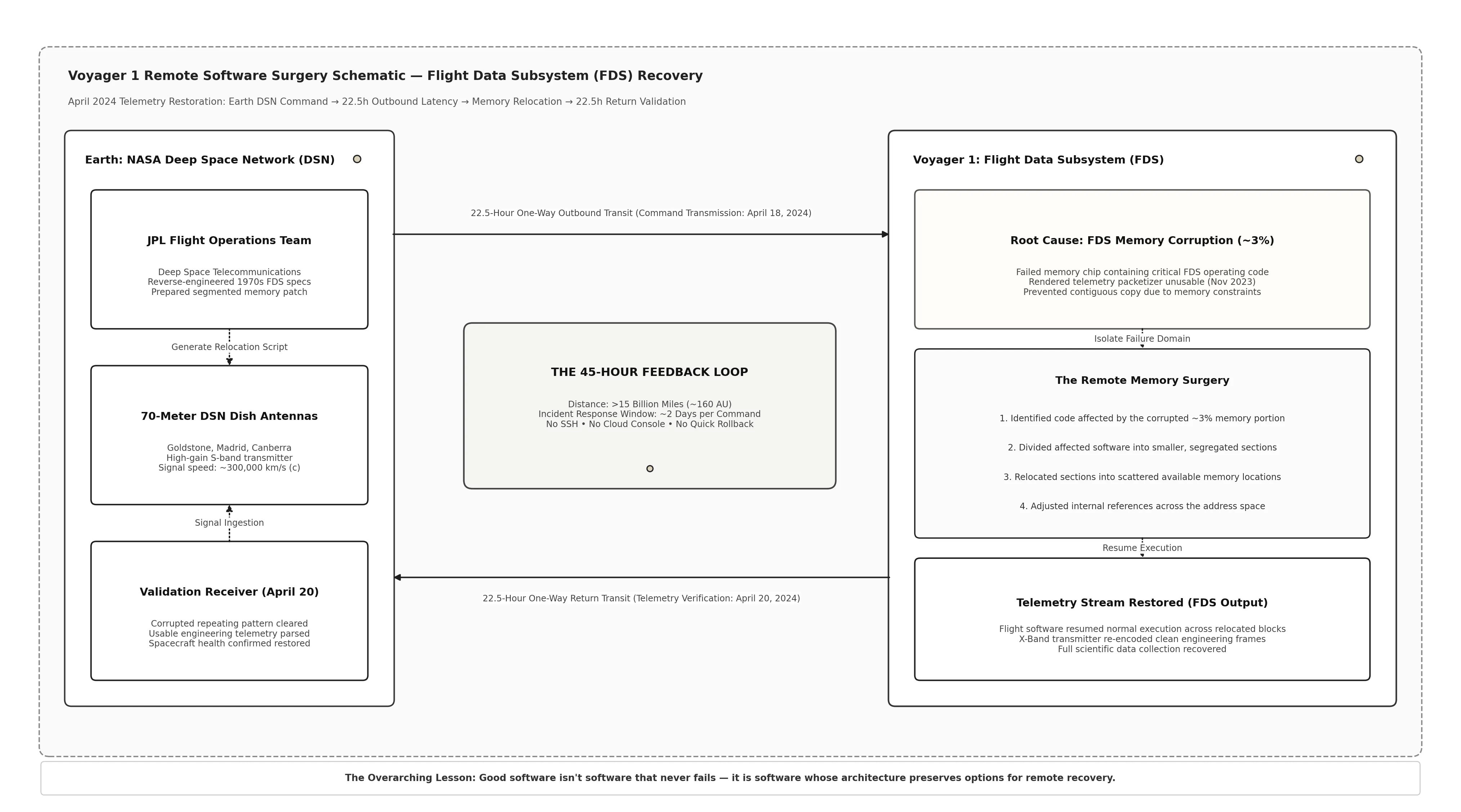
Figure 1: The 45-hour round-trip command and verification loop between NASA's Deep Space Network and Voyager 1's Flight Data Subsystem during the April 2024 recovery.
On April 18, 2024, NASA transmitted the commands across 15 billion miles of space. Then, they waited through the 22.5-hour transit, the spacecraft's execution, and the 22.5-hour return journey.
On April 20, 2024, telemetry signals arrived back at the Deep Space Network. The repeating binary pattern was gone. Usable engineering telemetry had returned. A machine launched in 1977 had received a surgical software modification from Earth while floating in interstellar space.
Six Timeless Engineering Lessons from Voyager 1
Documentation Is a Time Capsule, Not Bureaucracy
We often think of software in transient release cycles: v1, v2, v3, rewrite, migration. But some software becomes infrastructure, and infrastructure outlives individual careers. The engineers who designed the original FDS in the 1970s were no longer in the room in 2024. Today's engineers could only succeed because earlier engineers left behind clear schematics, memory maps, and design rationale. Ask yourself: If you left your company tomorrow, could someone understand why your system was designed the way it was?
Resilience Means Preserving a Path to Recovery
Most application software is built around the happy path: the database responds, the network is clean, the disk is intact. But real systems encounter memory leaks, corrupted disks, network partitions, and unexpected data formats. Voyager didn't survive because it was immune to failure; it survived because its architecture gave engineers a pathway to diagnose and recover when components broke down.
Deployability Must Be Baked into the Foundation
Modern developers push code continuously with instantaneous CI/CD rollbacks. But when an update takes 45 hours round-trip, every command matters. A system that cannot be safely inspected and updated after deployment is a ticking time bomb. The ability to modify a system in production is not merely an operational convenience; it is an architectural superpower.
Resource Scarcity Enforces Architectural Discipline
A modern smartwatch has exponentially more compute, memory, and storage than Voyager 1. Yet modern applications frequently collapse under minor configuration drifts. Severe hardware constraints forced 1970s engineers to think deeply about every byte, every failure mode, and every communication boundary. Abundant compute often masks sloppy design; strict constraints force elegance.
Tools Expire, Principles Endure
The magnetic tape recorders and custom silicon chips aboard Voyager are ancient by modern standards. But the core engineering principles—modular decomposition, failure isolation, telemetry visibility, and conservative state management—are as vital today for distributed microservices as they were in 1977.
Preserve Options When Everything Breaks
Good architecture does not guarantee that components will never fail. Hardware will degrade, networks will drop packets, and memory will corrupt. Great architecture ensures that when failure occurs, the operators still possess options to inspect, isolate, and recover.
The 5-Point “Voyager Test” for Modern Production Systems
You don't need to be building an interstellar spacecraft to apply these lessons. Every software team building backend services, distributed systems, or embedded software should subject their architecture to the Voyager Test:
If the original developers leave your team tomorrow, can an engineer who joined yesterday understand the system's design and operational boundaries using only the existing documentation?
When a critical dependency, database replica, or third-party service fails, does your system retain an accessible diagnostic interface, or does it lock operators out completely?
Can you safely apply emergency hotfixes, reconfigure routing, or drain degraded nodes in production without requiring a catastrophic cold restart of the entire platform?
What happens when fundamental environmental assumptions fail—such as unexpected 40-second network latency, disk write-locks, or silent data corruption? Does the system fail gracefully or cascade into total blackout?
If this software continues operating for five, ten, or twenty years without major rewrites, will future maintainers be able to decipher why crucial architectural trade-offs were made?
Conclusion: What “Production Ready” Truly Means
We often tell ourselves that a feature is “production ready” when the unit tests pass, the staging deployment succeeds, and the monitoring dashboard displays green.
Voyager 1 challenges us to adopt a much deeper standard.
A truly production-ready system is one that respects the inevitable passage of time. It acknowledges that hardware decays, teams turn over, environments drift, and unexpected failures will happen.
Voyager's enduring message isn't that NASA built an indestructible machine. It is that its engineers left behind enough visibility, simplicity, and control that future generations of engineers could reach across billions of miles of space and give it new life.
The Final Takeaway
“Sometimes, the most important feature of software isn't what it does when everything goes right. It's what options it gives you when everything goes wrong.”