


1. The Day the Illusion Dissolved
Ask an early-career engineer what Amazon Web Services is, and you will almost certainly receive an answer framed around retail and convenience: “It’s where you rent computers on the internet instead of buying physical hardware.”
For a long time, I held that exact mental model. I viewed AWS through the lens of a developer building local applications—a massive, labyrinthine web dashboard where you click a few dropdowns to spin up a Linux instance, create a database, point a DNS record, and host an API. It felt like a utility company: you turn on the faucet, compute comes out, and at the end of the month, you pay the water bill.
Then I spent 27 rigorous, hands-on hours completing the AWS Cloud Quest Solutions Architect immersion.
During that journey, working through dozens of real architectural dilemmas, the superficial illusion shattered. I realized that viewing AWS as a collection of commercial products completely misses the point.
The Foundational Epiphany
AWS is not a product catalog. It is a living, physical and logical codification of distributed systems engineering principles.
When you strip away the branding, the marketing names, and the web console, AWS is essentially an operational encyclopedia of how human beings solved the hardest problems of distributed scale: latency, concurrency, partial network failure, storage permanence, and autonomic self-healing.
Understanding those solutions doesn't just make you an AWS user. It transforms you from someone who writes code into someone who designs resilient software systems.
2. The First Axiom: Failure Is Not an Exception; It Is the Default State
In traditional software development on a single machine or local server, failure is treated as an anomaly. A null pointer is a bug to be caught. An out-of-memory error is a crisis. The engineer's subconscious goal is to design a software environment where nothing ever breaks.
In distributed cloud systems, that philosophy is suicidal.
When you scale from one server to ten thousand servers, the laws of large numbers take over. If a hard disk has an annual failure rate of 1%, a cluster of 100,000 disks will experience roughly three hard drive failures every single day. Power supplies overheat. Backplanes drop packets. Undersea fiber-optic cables get severed by ship anchors. Construction crews accidentally sever municipal power lines.
As Werner Vogels, CTO of Amazon, famously summarized: “Failures are a given and everything will eventually fail over time.”
Treats failures as rare exceptions. Relies on vertically beefy hardware. If the machine crashes, the application enters an emergency outage until an engineer intervenes.
Treats failure as mathematical certainty. Decouples dependencies so individual node terminations are routine, silent, and self-recovering.
Physical Blast Radiuses: Regions and Availability Zones
Look closely at AWS global infrastructure. Why doesn't Amazon simply build one colossal, ultra-efficient megacenter in each country?
Because of the Blast Radius Principle. An AWS Region is not a single building; it is a geographic area containing multiple, completely isolated data center clusters known as Availability Zones (AZs).
Each AZ is physically separated by meaningful distance (often kilometers apart to guard against localized floods, power grid disruptions, or fires), yet connected by low-latency private fiber optics. Crucially, each AZ has its own independent utility power substations, cooling chillers, backup diesel generators, and redundant network transit feeds.
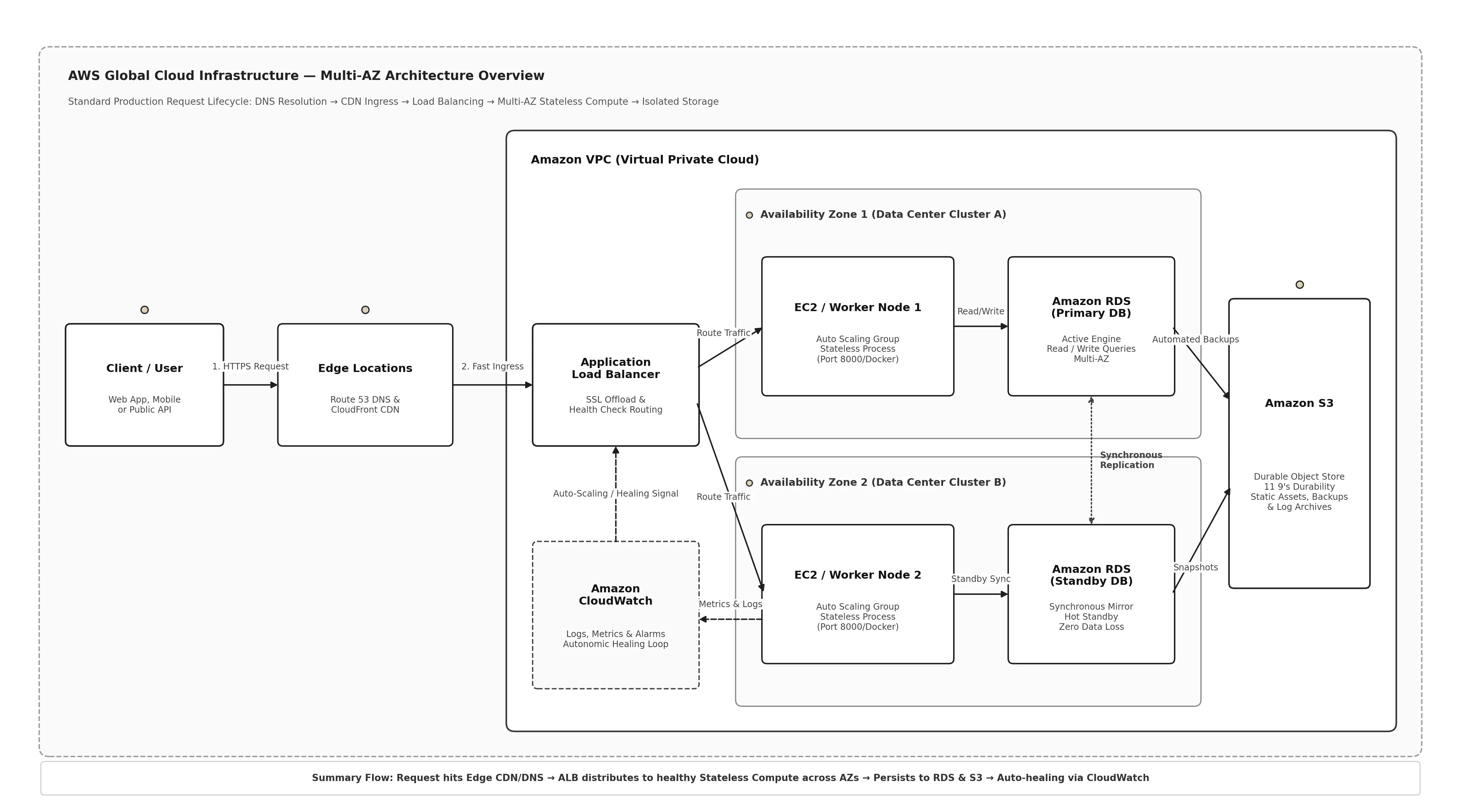
Figure 1: How a user request travels through AWS—from global Edge Locations to an Application Load Balancer, routing traffic into isolated, auto-scaling Availability Zones backed by synchronized persistence.
When an architect designs a system to run across multiple AZs as shown in the diagram above, they are not simply checking an enterprise redundancy box. They are building a system where an entire data center can literally experience a catastrophic blackout, and the end-user on their phone never even notices a dropped HTTP request.
3. The Great Decoupling: Severing Compute from Durable State
If there is a golden rule in distributed architecture, it is this: State is the enemy of effortless scalability.
On your development laptop, your code, your active memory variables, your session files, and your local SQLite or Postgres database all reside on the exact same physical SSD. This creates an invisible coupling that developers instinctively replicate in their early cloud deployments.
AWS forced the software engineering industry to unlearn this habit by systematically tearing compute and storage apart.
Stateless execution engines. Can be terminated, scaled, or replaced in seconds without data loss.
Low-latency virtual disk attached over the network, automatically replicated within its Availability Zone.
Globally distributed, key-value blob persistence designed for 99.999999999% (11 9s) of durability across minimum 3 AZs.
Why does this separation matter so deeply to code design?
Because the moment an application's execution environment contains zero permanent local state, compute instances become completely disposable. You stop treating your servers like beloved pets with names and individual histories, and begin treating them like interchangeable cattle.
If a server begins exhibiting memory leaks or abnormal CPU spikes, you do not spend three days debugging live state on the box. You terminate it. An automated controller instantly launches a pristine clone, attaches it to the shared database or object store, and the cluster continues humming.
4. The Math of Scale: Dynamic Elasticity and Autonomic Healing
Before cloud virtualization, capacity planning was an agonizing gamble. If your e-commerce platform anticipated peak traffic on Black Friday, you had to order racks of physical servers in August, mount them in a server cage, configure the cabling, and keep them running continuously—even if they sat 92% idle for eleven months of the year.
Cloud architecture replaced static provisioning with closed-loop autonomic control theory.
Auto Scaling: Demand-Driven Proportionality
Instead of guessing capacity, an Auto Scaling Group (ASG) monitors telemetry (CPU utilization, queue depth, request latency). When request volume spikes, new instances spin up within seconds behind an Elastic Load Balancer. When traffic subsides at 3:00 AM, excess instances are cleanly drained and de-provisioned, shrinking operational costs proportionally.
Auto Healing: Negative Feedback Self-Repair
Auto Scaling is not merely for traffic spikes; it is an active self-healing mechanism. An ASG maintains a declared target state (e.g., “maintain minimum 4 healthy nodes across AZ-1 and AZ-2”). If an underlying physical hardware blade fails or an application process hangs, health checks immediately mark the instance as unhealthy, terminate it, and provision a replacement to restore equilibrium.
Notice the profound engineering concept here: The system does not require human intervention to heal itself from expected hardware mortality.
This is the exact same architectural pattern that Kubernetes popularized with declarative state reconciliation loops, and that Erlang pioneered decades earlier with its supervisor trees: Crash early, isolate cleanly, and let an automated supervisor restore desired state.
5. Observability as an Architectural Primitive
In novice software design, logging is treated as an afterthought—a scattering of console.log() or print() statements hastily added when something breaks in staging.
In large-scale distributed systems, unobservable code is dead code.
When an end-user clicks a checkout button on a modern cloud app, that single request might traverse an edge CDN, pass through an API Gateway, invoke a serverless Lambda function, query a Redis cache, trigger an asynchronous SNS notification, enqueue an SQS message, and persist a record to DynamoDB.
If that request fails or takes 8 seconds, where did the bottleneck occur? Was it database lock contention? Network socket exhaustion? Cold start latency? A noisy neighbor on the shared hypervisor?
Services like Amazon CloudWatch and AWS X-Ray exist because distributed architectures require observability to be built directly into the foundational plumbing:
- •Structured Telemetry: Metrics are collected at sub-minute granularity to feed automated threshold alarms and autoscaling triggers.
- •Distributed Tracing: Injecting unique correlation IDs (Trace IDs) into incoming request headers allows you to follow the exact lifecycle of a transaction across ten different microservices.
- •Proactive Anomaly Detection: Applying statistical models to traffic patterns to identify degradations before end-users file bug reports.
Observability is not about reading logs after a disaster; it is the sensory nervous system that allows the infrastructure to understand its own health and execute automated remediation.
6. The Seven Architectural Archetypes
One of the most intimidating aspects of AWS for beginners is its sheer volume. With over 200 distinct services, it is easy to feel overwhelmed by the endless deluge of three-letter acronyms: EC2, S3, RDS, SQS, SNS, VPC, IAM, KMS.
During my 27-hour quest, I realized something liberating: You do not need to memorize 200 individual tools. You only need to understand the fundamental architectural archetypes.
Almost every tool in modern cloud computing fits into one of seven recurring archetypes:
Durable Object Storage vs. Ephemeral Block Storage
Understanding the trade-off between massive write-once durability with HTTP access (S3) versus high-IOPS, raw filesystem blocks attached to a single host (EBS).
Long-Running Servers vs. Event-Driven Ephemeral Compute
Choosing between persistent virtual machines (EC2) that maintain warm memory versus event-triggered serverless functions (AWS Lambda) that exist only for the milliseconds required to handle an event.
Relational ACID vs. Horizontally Partitioned Key-Value Data
Knowing when your business logic requires strict ACID transactions and relational joins (RDS / PostgreSQL) versus single-digit millisecond latency at petabyte scale via partition keys (DynamoDB).
Private Network Overlays and Isolated Perimeters
Enforcing zero-trust network boundaries with Virtual Private Clouds (VPCs), separating public ingress subnets from completely private, non-routable database subnets.
Temporal Decoupling via Message Queues and Event Buses
Eliminating synchronous waiting between upstream producers and downstream consumers using point-to-point queues (SQS) and fan-out pub/sub topics (SNS / EventBridge).
Declarative Infrastructure as Code (IaC)
Replacing human click-ops in the browser console with reproducible, version-controlled templates (AWS CloudFormation, Terraform) to ensure environments are deterministic and auditable.
Edge Acceleration and Geographical Caching
Terminating TLS handshakes and serving static assets from hundreds of globally distributed Edge Locations (CloudFront) to defeat the physical speed of light across transcontinental fiber.
Once you master these archetypes, the vendor becomes secondary. Whether you are using AWS, Google Cloud Platform, Microsoft Azure, or open-source self-hosted primitives (MinIO, RabbitMQ, WireGuard, CockroachDB), the mental model remains 100% identical.
7. The Big Shift: From “Building Apps” to “Designing Systems”
When I reflect on who I was as a programmer before diving into deep cloud architecture versus who I am today, the distinction is unmistakable:
- • Focused almost entirely on writing algorithmic code and business logic.
- • Assumed network calls are instant and always succeed.
- • Viewed servers as permanent machines running a codebase.
- • Debugged issues by printing logs on local machine.
- • Focused on data flows, latency budgets, and failure isolation.
- • Assumed network partitions and packet loss are inevitable.
- • Viewed servers as disposable nodes governed by feedback loops.
- • Engineered self-healing architectures with automated observability.
A software engineer writes code that solves a business problem. A Solutions Architect designs the living ecosystem that protects that code from the brutal realities of the physical world—hardware degradation, traffic stampedes, network latency, and physical disasters.
This is why learning AWS architecture is so deeply rewarding. It isn't vocational training on how to navigate Amazon's proprietary UI. It is a masterclass in modern systems engineering.
8. The Invariance Test: A 5-Point Architecture Checklist
Whenever you design a software system—whether on AWS, a VPS, or a local distributed cluster—apply these five first-principles questions to test its architectural resilience:
If this specific database replica, cache node, or worker process crashes right now, what percentage of your users experience an error? If the answer is 100%, your system lacks isolation boundaries.
Can you randomly issue a kill -9 on any web or API instance in production during peak traffic without corrupting user state or dropping sessions? If not, compute and state are still tightly coupled.
Does your client request block synchronously while waiting for third-party webhooks, PDF generation, or email delivery? Decouple these workflows into persistent queues with backpressure and dead-letter queues.
Does restoring a crashed node or scaling up during a traffic wave require a human being to wake up, read an alert, and log in to a terminal? Systems should heal and scale through autonomic feedback loops.
If your primary production environment were completely wiped out, could you stand up an identical, functioning copy in an entirely different region purely by running a declarative script?
9. Conclusion: The Power of Invariance
In software engineering, technologies have a shockingly short half-life. JavaScript frameworks emerge and disappear in three-year cycles. Database query syntax evolves. Cloud vendors rename their dashboards, launch new AI wrappers, and deprecate old APIs.
If your entire identity as an engineer is tied to memorizing where specific buttons live in a web console, you will spend your entire career anxious about being replaced by the next dashboard redesign or automation script.
But systems thinking is different.
The principles of distributed consensus, fault isolation, state decoupling, autonomic control, and queue-driven asynchrony do not expire. They governed mainframe networks in the 1970s, they power planetary-scale cloud infrastructure today, and they will govern whatever decentralized computing paradigms emerge decades from now.
The Final Takeaway
“Because tools change… But concepts stay forever.”
Don't just learn AWS to pass an exam or configure an instance. Learn it to understand how modern civilization builds digital systems that never stop running.